


Page-cited answers from embedded & firmware reference docs — for coding agents that can't afford to guess a register value.






Official MCP Registry Namespace: ai.byteask/embedded-docs · Remote MCP Endpoint: https://mcp.byteask.ai/mcp
Quickstart · Tools · Connect a client · Configuration · Hosted server · Contributing
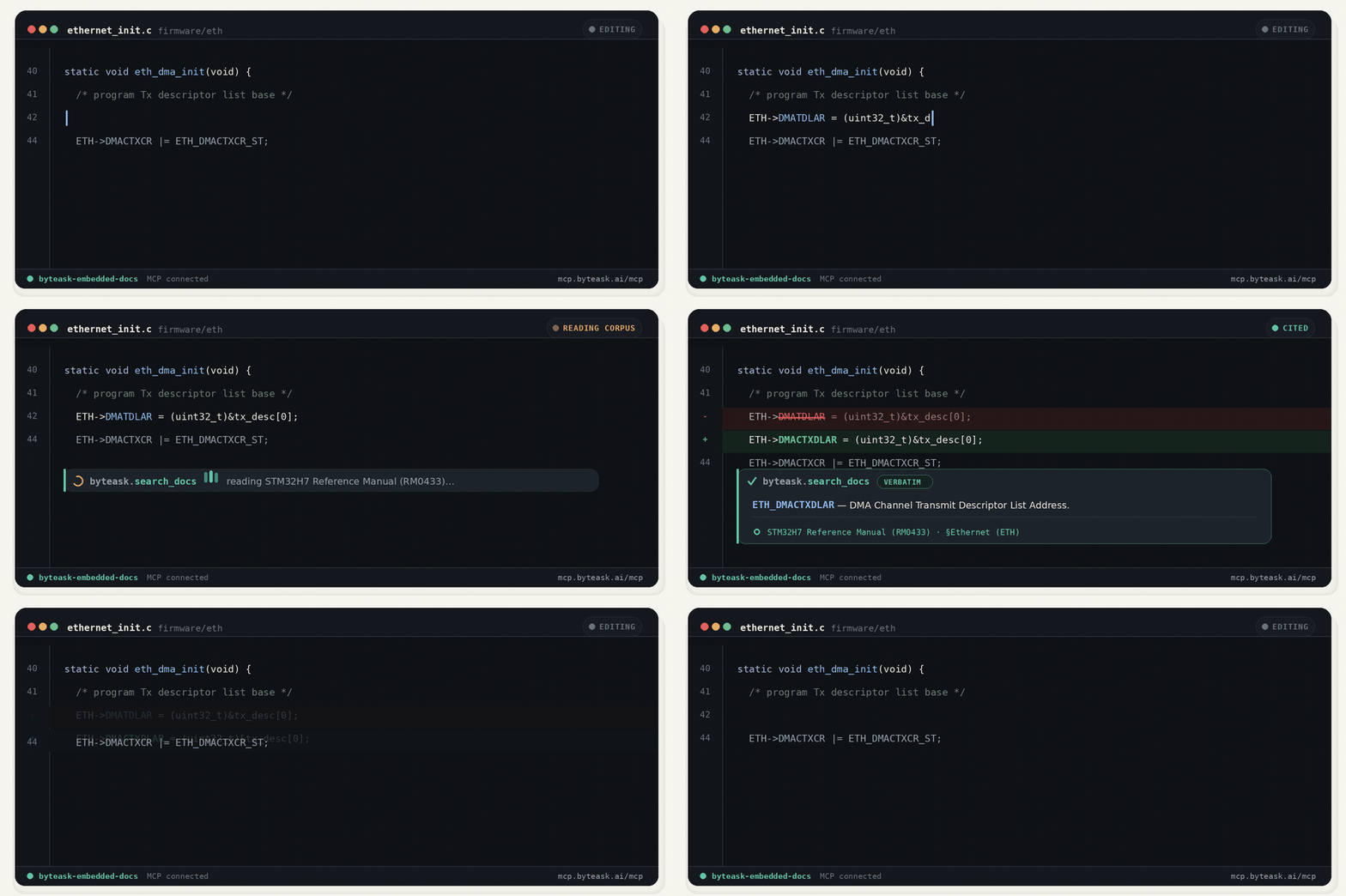
ByteAsk Embedded MCP is the open-source server behind ByteAsk Embedded Docs: a source-grounded, page-cited evidence-retrieval MCP server for coding agents (Claude Code, Codex, Cursor) that write firmware / driver / protocol code and need exact facts — SunSpec points, register offsets, Modbus function codes, trip thresholds, SCPI commands, API symbols.
It returns verbatim snippets with page citations — never an authored answer — and when nothing is relevant enough it says no match rather than fabricate. Every document is treated equally: no authority layer, no filters.
Note
What's in this repo: the MCP server — tools, transports (stdio + Streamable HTTP), bearer auth, DNS-rebinding protection, result rendering — plus a small, pluggable retrieval interface.
What's not in this repo: the retrieval engine and the document corpus. How
documents are parsed, chunked, embedded, and ranked, and the licensed source
material itself, sit behind the SearchBackend
seam and power the hosted endpoint at https://mcp.byteask.ai/mcp. This repo ships
an in-memory SampleBackend (a few
illustrative, public-knowledge records) so the server runs out of the box.
- Cited, or nothing. Every hit is verbatim source text with a section + page citation. On a miss it returns an honest "no confident match" — it never invents a register value.
- Built for coding agents. The tool descriptions and triggers are tuned so agents
call
search_docsreflexively the moment they see a hex literal, a Modbus code, an IEEE clause, a SCPI verb, or an MCU part number — before answering from memory. - Two transports, one server.
stdiofor local agents, Streamable HTTP for hosted. - Bring your own retrieval. The search engine is a two-method interface — swap in
anything behind
BYTEASK_BACKENDwithout touching the server. - Zero-setup demo. The bundled
SampleBackendruns immediately. No API keys.
Requires Python ≥ 3.10 and uv.
uv sync
uv run byteask-embedded-mcp        # run as an MCP server (stdio)
That's it — the bundled SampleBackend serves a couple of illustrative records, so
search_docs works immediately. Run the offline tests with uv run pytest.
The hosted server speaks Streamable HTTP at https://mcp.byteask.ai/mcp and is
backed by the full licensed corpus.

Claude Code:
claude mcp add --transport http byteask-embedded-docs https://mcp.byteask.ai/mcpCodex, Cursor, and other clients (mcp-remote)
{
  "mcpServers": {
    "byteask-embedded-docs": {
      "command": "npx",
      "args": ["-y", "mcp-remote", "https://mcp.byteask.ai/mcp"]
    }
  }
}The project-scoped .mcp.json registers the stdio server for clients
that read it. Manually, for Claude Code:
claude mcp add byteask-embedded-docs -- uv run byteask-embedded-mcpInput is natural language (or an exact identifier). Output is compact markdown.
| Tool | What it does |
|---|---|
search_docs(query, limit=8) |
Search the corpus; return ranked, page-cited evidence. Each hit has a document title, a section + page citation, the verbatim snippet, and a result_id. A "no confident match" response means not found — do not fabricate. |
get_context(result_id) |
Expand a hit to its full source section. |
request_document(request) |
Ask for a missing document to be added (logged server-side). |
Example output:
## Results for "what Modbus function code writes multiple registers"

### Sample — Modbus Application Protocol (illustrative) — §6.12, p.30
> Function code 16 (0x10), Write Multiple Registers, writes a block of contiguous
> holding registers (1 to 123 registers) in a remote device. ...
_ref: sample:modbus-fc16_The server depends only on a two-method interface
(backend.py):
class SearchBackend(Protocol):
    def search(self, query, limit=8, effort=None) -> dict: ...
    def get_context(self, result_id, effort=None) -> dict: ...
Implement it, expose a factory make_backend(config) -> SearchBackend, and point the
server at it:
BYTEASK_BACKEND="my_pkg.my_module:make_backend"The exact return-value contracts are documented at the top of backend.py.
All settings are environment variables (loaded from .env; see .env.example).
| Variable | Default | Notes |
|---|---|---|
BYTEASK_BACKEND |
— | module:callable returning a SearchBackend; empty → SampleBackend |
BYTEASK_LOGS |
logs |
where query / request JSONL logs are written |
MCP_TRANSPORT |
stdio |
stdio (local agents) or http |
MCP_HTTP_HOST / MCP_HTTP_PORT |
127.0.0.1 / 8000 |
HTTP bind address |
MCP_HTTP_AUTH_TOKEN |
— | bearer token for HTTP (empty = unauthenticated, dev only) |
MCP_ALLOWED_HOSTS |
— | comma-separated hosts allowed in the Host header (* disables) |
LOG_LEVEL |
INFO |
stderr log verbosity |
Running over HTTP
MCP_TRANSPORT=http MCP_HTTP_AUTH_TOKEN=$(openssl rand -hex 32) \
  uv run byteask-embedded-mcp --host 0.0.0.0 --port 8000
Clients then send Authorization: Bearer <token>. The bundled bearer check is a
shared-secret stub — replace it with real auth (OAuth 2.1 resource server, mTLS,
or a trusted reverse proxy) before exposing publicly. DNS-rebinding protection stays
on independently via MCP_ALLOWED_HOSTS.
You don't need to run anything to use ByteAsk Embedded Docs. The hosted server gives Claude Code, Codex, Cursor, and any MCP client exact, page-cited facts from embedded and firmware reference docs — register maps, protocol function codes, SCPI commands, standard thresholds, datasheet specs. The guarantee: verbatim source, or "no match" — never an invented value.
| Name | byteask-embedded-docs |
| Endpoint | https://mcp.byteask.ai/mcp (Streamable HTTP) |
| Docs & per-client setup | https://docs.byteask.ai/embedded |
This repository is the open-source server that powers that endpoint.
src/byteask_embedded_mcp/
  server.py     # FastMCP app + 3 tools (search_docs, get_context, request_document)
  backend.py    # SearchBackend protocol + in-memory SampleBackend (swap for real retrieval)
  render.py     # structured result -> compact markdown
  http_auth.py  # Streamable HTTP entrypoint + stub bearer-token guard
  config.py     # server config (transport, logging, backend selection)
  schemas.py    # Hit / Section result types
  obs.py        # per-call JSONL logging
tests/          # offline unit tests (renderer, backend, server tools)
assets/         # README demo GIF + its deterministic generator
- stdout stays clean in stdio mode (it is the JSON-RPC channel); all logs go to
stderr /
logs/*.jsonl. - The HTTP bearer check is a stub — unauthenticated if no token is set, a shared secret at best. Harden it before exposing widely.
- DNS-rebinding protection is on by default for the HTTP transport.
PRs and issues are welcome.
uv sync            # install (incl. dev tools)
uv run pytest      # run the offline test suite
A few conventions to keep the server clean:
- The backend seam is the extension point. Retrieval internals (parsing, chunking,
embeddings, ranking) are intentionally out of scope here — build them behind
SearchBackendin your own package, not in this repo. - Keep the dependency surface small and the stdio path free of the HTTP stack.
- Add a test for new behavior; the suite is fully offline (no network, no keys).