
Fire in da houseTop Tip:Paying $100+ per month for Perplexity, MidJourney, Runway, ChatGPT and other tools is crazy - get all your AI tools in one site starting at $15 per month with Galaxy AI Fire in da houseCheck it out free

volatility3-mcp

MCP.Pizza Chef: Kirandawadi

Volatility3 MCP Server integrates the advanced Volatility3 memory forensics framework with MCP clients, enabling LLMs to analyze memory dumps, detect malware, and automate forensic workflows through natural language commands. It simplifies complex memory forensics tasks, making them accessible to non-experts by automating multi-step processes and providing detailed insights into Windows and Linux memory dumps using various plugins.

Use This MCP server To

Analyze Windows and Linux memory dumps via natural language queries Detect malware and suspicious processes in memory dumps Automate forensic workflows for memory analysis Enable LLMs to perform memory forensics without command-line expertise Provide detailed process and kernel inspection from memory dumps Integrate memory forensics into AI-enhanced security workflows Generate forensic reports from memory dump analysis Support incident response with automated memory analysis

README

Volatility3 MCP Server

Introduction

Volatility3 MCP Server is a powerful tool that connects MCP clients like Claude Desktop with Volatility3, the advanced memory forensics framework. This integration allows LLMs to analyze memory dumps, detect malware, and perform sophisticated memory forensics tasks through a simple, conversational interface. Architecture Diagram
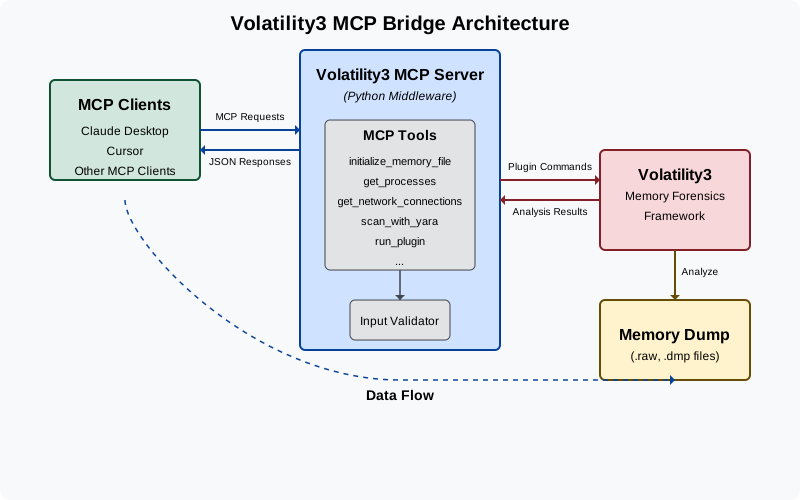
What This Solves

Memory forensics is a complex field that typically requires specialized knowledge and command-line expertise. This project bridges that gap by:

  • Allowing non-experts to perform memory forensics through natural language
  • Enabling LLMs to directly analyze memory dumps and provide insights
  • Automating common forensic workflows that would normally require multiple manual steps
  • Making memory forensics more accessible and user-friendly

Features

  • Memory Dump Analysis: Analyze Windows and Linux memory dumps using various plugins
  • Process Inspection: List running processes, examine their details, and identify suspicious activity
  • Network Analysis: Examine network connections to detect command and control servers
  • Cross-Platform Support: Works with both Windows and Linux memory dumps (macOS support coming soon)
  • Malware Detection: Scan memory with YARA rules to identify known malware signatures

Demo

Demo Video

You can also find a detailed presentation on this tool here.

Configuration

  1. Clone this repository:
  2. Create a virtual environment:
    python -m venv environ
    source environ/bin/activate
  3. Install the required dependencies:
    pip install -r requirements.txt

You can use this project in two ways:

Option 1: With Claude Desktop

  1. Configure Claude Desktop:
    • Go to Claude -> Settings -> Developer -> Edit Config -> claude_desktop_config.json and add the following
         {
             "mcpServers": {
             "volatility3": {
                 "command": "absolute/path/to/virtual/environment/bin/python3",
                 "args": [
                 "absolute/path/to/bridge_mcp_volatility.py"
                 ]
             }
             }
         }

      Tools available in Claude Desktop
  2. Restart Claude Desktop and begin analyzing the memory dumps.

Option 2: With Cursor (SSE Server)

  1. Start the SSE server:
    python3 start_sse_server.py
  2. Configure Cursor to use the SSE server:
    • Open Cursor settings
    • Navigate to Features -> MCP Servers
    • Add a new MCP server with the URL http://127.0.0.1:8080/sse Cursor Composer
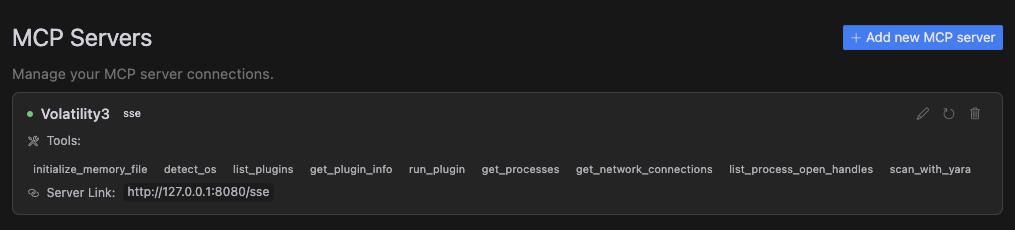
  3. Use the Cursor Composer in agent mode and begin analyzing memory dumps.

Available Tools

  • initialize_memory_file: Set up a memory dump file for analysis
  • detect_os: Identify the operating system of the memory dump
  • list_plugins: Display all available Volatility3 plugins
  • get_plugin_info: Get detailed information about a specific plugin
  • run_plugin: Execute any Volatility3 plugin with custom arguments
  • get_processes: List all running processes in the memory dump
  • get_network_connections: View all network connections from the system
  • list_process_open_handles: Examine files and resources accessed by a process
  • scan_with_yara: Scan memory for malicious patterns using YARA rules

Contributing

Contributions are welcome! Please feel free to submit a Pull Request.

volatility3-mcp FAQ

How does Volatility3 MCP Server simplify memory forensics?
It allows users to perform complex memory analysis through natural language commands, removing the need for command-line expertise and automating multi-step forensic workflows.
Can Volatility3 MCP Server analyze both Windows and Linux memory dumps?
Yes, it supports memory dump analysis for both Windows and Linux operating systems using various Volatility3 plugins.
How do LLMs interact with Volatility3 MCP Server?
LLMs connect via MCP clients to send natural language queries that the server translates into forensic commands and returns structured analysis results.
Is Volatility3 MCP Server suitable for non-experts?
Yes, it is designed to make memory forensics accessible to users without specialized knowledge by automating complex tasks and providing conversational interfaces.
What kind of forensic insights can Volatility3 MCP Server provide?
It can detect malware, inspect processes, analyze kernel structures, and generate detailed forensic reports from memory dumps.
How does this server integrate with other MCP components?
It acts as an MCP server exposing Volatility3 functionality, allowing MCP clients and LLMs to leverage memory forensics capabilities seamlessly.
Does Volatility3 MCP Server support automation of forensic workflows?
Yes, it automates common forensic tasks that typically require multiple manual steps, improving efficiency and accuracy.
What are the prerequisites for using Volatility3 MCP Server?
Users need access to memory dump files and an MCP client capable of communicating with the server to utilize its features.